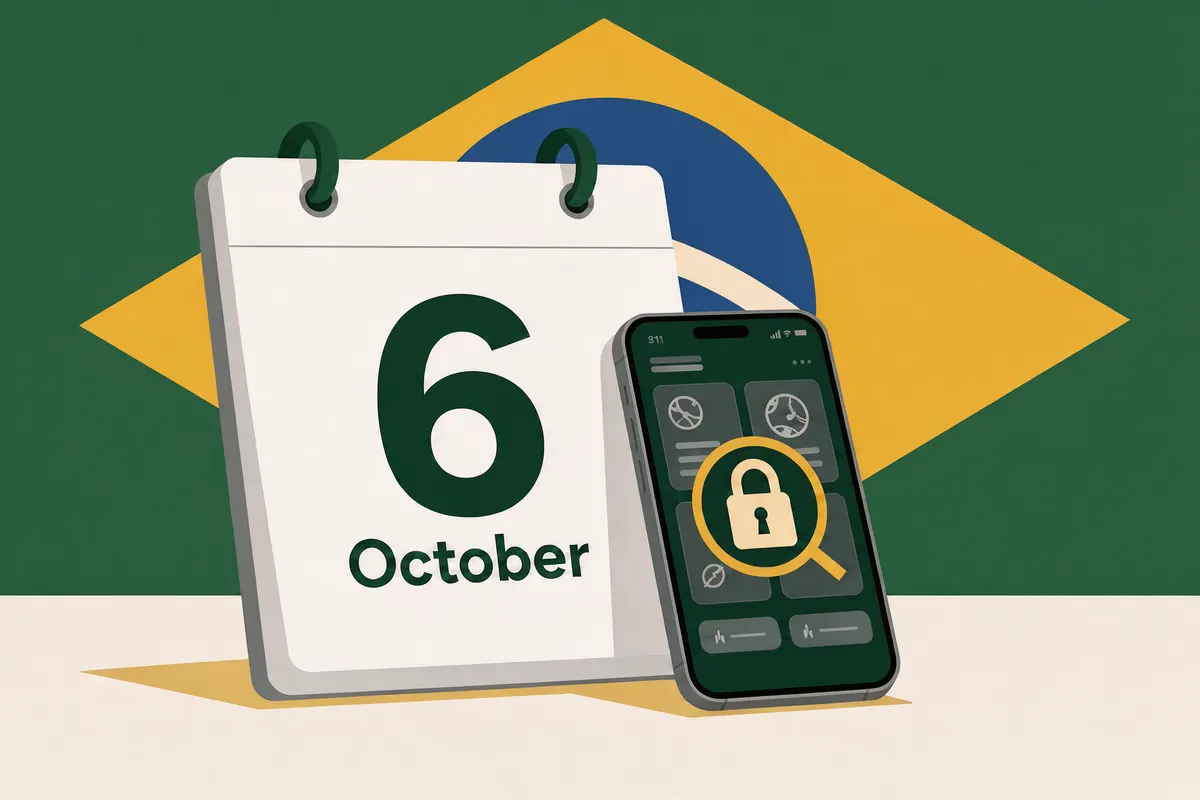
23:59 on 5 October is the hard stop for your balance
That single timestamp tells you most of what you need to know about Brazil’s betting shutdown deadline. Players can voluntarily withdraw whatever sits in their account until one minute before midnight on 5 October. From 6 October, operators are required to make their websites and applications unavailable. No new deposits have been accepted since the rule was published on 25 September.
The instrument behind it is Provisional Measure No. 1,394, signed by President Luiz Inácio Lula da Silva. It prohibits the operation, offering, intermediation and advertising of fixed-odds betting throughout Brazil, and it took effect the moment it was published. If you have been reading headlines that frame this as a crackdown on rogue offshore sites, read the next section carefully, because the scope is wider than that.
What does Brazil’s betting shutdown deadline actually require?
Three obligations, stacked on a short clock. New player deposits were banned immediately on publication. Available balances can be withdrawn voluntarily until 23:59 on 5 October. Sites and apps must be inaccessible from 6 October.
Alongside that, the measure blocks the granting of any new fixed-odds betting authorisations, and existing authorisations formally expire 30 days after publication. Note the gap: operators have to stop offering bets well before their paperwork technically lapses. The licence is not the thing that switches off first, the product is.
The prohibition covers bets on real sporting events and online games, whether they are offered through physical or virtual channels. Other lottery products authorised by law are not affected.
| Date | What applies |
|---|---|
| 25 September (publication) | Measure takes effect immediately. New deposits prohibited. Operation, offering, intermediation and advertising of fixed-odds betting banned. No new authorisations can be granted. |
| Until 23:59 on 5 October | Players may voluntarily withdraw available balances. |
| From 6 October | Operators must make websites and applications inaccessible. |
| 30 days after publication | Existing federal, state and Federal District authorisations formally expire. |
Which betting sites does this cover, and is it only unlicensed ones?
It is not only unlicensed betting sites in Brazil. The measure applies across the board: federally authorised operators, operators running on state or Federal District authorisations, and offshore operators targeting people located in Brazil. That last point matters, because the most common workaround in any shutdown is a grey-market site telling Brazilian users it is somehow outside the rules. Under this measure, it is not.
Unlicensed sites were already operating outside the framework before 25 September. What changes for them is that the lawful side of the market, the part they used to be compared against, is no longer there as a benchmark, and the prohibition on offering and advertising fixed-odds betting now applies to the whole country rather than to a licensing gap.
If you are trying to work out whether a brand was ever compliant in the first place, the markers are the ones that applied under the regulated regime: an authorisation granted by the Ministry of Finance’s betting and prizes secretariat (the unit that took over the brief from SECAP), a Brazilian corporate entity, local payment rails, and a bet.br domain rather than a generic .com redirect. A site missing all of those was never part of the authorised market.
Affiliates should read the word “intermediation” twice. A prohibition that reaches intermediation and advertising is not aimed solely at the company holding the licence. Review-site placements, paid media, influencer deals and affiliate traffic pointed at Brazilian users all sit inside that language.
How will betting regulation enforcement actually work?
The first layer is self-execution. The measure puts the obligation on operators themselves: stop deposits, stop offering bets, take the site and app offline. For an authorised operator with a Brazilian entity, local staff, bank relationships and a licence it may want back one day, that obligation is the whole enforcement story. Non-compliance is a regulatory and criminal exposure problem, not a technical cat-and-mouse game.
The second layer is the one that applies to anyone who ignores the first. Brazil’s authorities have an established toolkit for unauthorised betting, and these are the levers that have historically been used:
- Domain and access blocking. Requests routed through the telecoms regulator, Anatel, instruct internet service providers to block listed domains. Operators respond with mirror domains; the blocklist gets updated. It is attrition, not a clean switch.
- Payment restrictions. Deposits and withdrawals depend on banks, Pix rails and payment service providers that are supervised and risk-averse. Cutting processing is usually more effective than blocking a URL, because it kills the cash-in and cash-out at once.
- App store removal. Takedown requests to Apple and Google strip the native apps for Brazilian storefronts, which removes the easiest install path for mainstream users.
- Advertising and sponsorship action. With advertising prohibited, broadcasters, platforms, clubs and agencies become pressure points. Media money dries up faster than traffic does.
- Coordination. Finance ministry, telecoms regulator, financial supervisors, consumer protection bodies and public prosecutors acting together is what turns a written prohibition into a practical market exit.
Expect the visible market to go quiet quickly and the residual grey market to shrink slowly. That is how blocking regimes have behaved everywhere they have been tried.
What happens to your account, your balance and your open bets?
If you hold a balance, the window to move it is the voluntary withdrawal period that ends at 23:59 on 5 October. Practical steps, in order of how much time they take:
- Finish KYC now if it is incomplete. An unverified account is the single most common reason a withdrawal stalls, and after 6 October the site you need to upload documents to is supposed to be offline.
- Withdraw to the same method you deposited from. Mismatched source-of-funds is the second most common reason payouts get held.
- Screenshot everything: balance, transaction history, open bet slips, support tickets, and the operator’s own notice about the shutdown. If a dispute follows, that record is what you will be arguing from.
- Check the operator’s published notice for how it is handling bets still open at the cut-off, and keep the confirmation. Treatment of outstanding wagers is dealt with in the measure and in operator communications rather than by anything you can control from your account.
Do not assume your account will be reachable “for a few days after” to tidy things up. The obligation is for sites and apps to be inaccessible from 6 October, and planning around a grace period that may not exist is how balances get stranded.
Can you still bet after 6 October?
Not on fixed-odds betting in Brazil, legally. The prohibition covers sports betting and online games offered through physical or virtual channels, and it reaches operators based abroad that target people located in Brazil. Lottery products authorised by law are unaffected, which is a narrow carve-out, not a replacement market.
The alternative that will be marketed hardest at Brazilian users is an offshore mirror site promising business as usual. Think about what you actually get there: no local authorisation, no Brazilian consumer recourse, payment channels that are a target for restriction, and a balance you cannot escalate to any regulator if it is frozen. The downside is not a theoretical compliance point, it is your money sitting somewhere you have no claim.
If betting has been a routine for you, a market shutting down is a reasonable moment to use the tools you already have: deposit and loss limits while any account is still open, self-exclusion, and the support services available in Brazil. Our responsible gambling resources cover limit-setting and cool-off options. Gambling carries a built-in house edge, every product returns less than it takes over time, and no shutdown changes that arithmetic.
Where does this leave licensing and compliance for operators?
The licensing route is closed for now. The measure prevents the granting of new fixed-odds betting authorisations, and existing federal, state and Federal District permissions expire 30 days after publication. There is no application queue to join and no interim permit to apply for while the prohibition stands.
What there is, is a legislative clock. A provisional measure in Brazil has immediate force but is temporary: Congress has a limited window, 60 days and extendable once, to convert it into law, amend it, or let it lapse. That is where the real uncertainty sits for anyone holding Brazilian assets, staff or marketing contracts. Any constitutional or procedural challenge would run through the courts on its own timetable, and the sensible planning assumption is that neither route resolves quickly.
Until it does, compliance work is wind-down work: cease offering and advertising on the stated dates, honour withdrawals inside the voluntary window, document every player communication and payout, preserve records for regulators and auditors, retire Brazilian-facing creative and affiliate programmes, and track the congressional process rather than the rumour cycle. Affiliates and suppliers should audit where their Brazilian traffic and revenue is routed and assume intermediation is in scope.
For context on how neighbouring jurisdictions structure their permits, see our guides to Latin American licensing frameworks. The lesson of this deadline is the one compliance teams already know: in Brazil, the instrument that opens a market can close it in eleven days.