
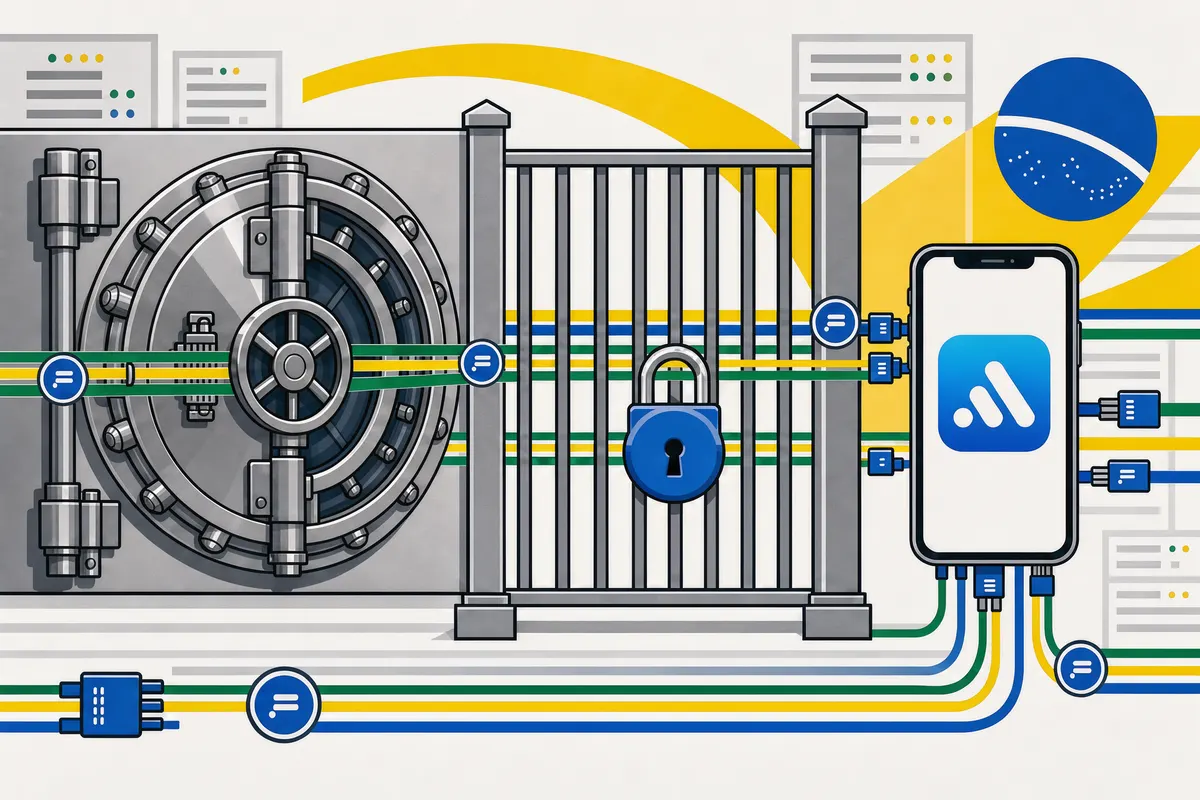
Forget the image of regulators chasing offshore bookmakers through foreign courts one domain at a time. The Brazil betting crackdown is not built on suing operators. It is built on conscripting the intermediaries that stand between a bettor and a bet: banks, payment institutions, telecom providers, app stores and internet platforms. Operators are the target, but they are not the enforcement surface. The pipes are.
That distinction matters more than any headline about a ban, because it changes who carries the legal risk. Under Provisional Measure No. 1,394, fixed-odds betting is prohibited throughout Brazil, including services offered from abroad to people located in the country. Licensed websites and applications must become inaccessible from 6 October, after which any continued offering of fixed-odds betting to people in Brazil is prohibited. Once the licensed market closes, there is no whitelist left to point at. Everything in the category becomes something an intermediary is expected to stop carrying.
Brazil’s new enforcement strategy: regulate the rails, not the operator
The structural shift here is away from operator-facing enforcement, where a regulator licenses, audits and fines the betting company itself, and toward intermediary-facing enforcement, where the state issues orders to the regulated entities it can actually reach. A Curaçao-registered sportsbook may be beyond practical reach. A Brazilian acquirer, a Pix participant or a mobile carrier is not.
Two ministries sit at the top of the chain. The Ministry of Finance and the Ministry of Justice and Public Security will be able to request the blocking or redirection of illegal betting websites. From there, the orders fan out through sector bodies that already have standing relationships with the companies that must act.
Anatel, the telecoms regulator, receives and distributes blocking orders to telecommunications providers and other internet-access intermediaries. The Brazilian Internet Steering Committee, CGI.br, is responsible for measures involving names registered under the “.br” domain. App stores and operating-system providers must prevent prohibited betting applications from being made available and remove them when directed by the authorities. Internet platforms more broadly are drawn into the same perimeter, alongside banks and payment institutions on the financial side.
One procedural point worth holding onto: a provisional measure takes effect immediately but is not permanent law. It lapses unless Congress converts it within the constitutional window. So the enforcement machinery described below is being stood up while the underlying instrument is still politically live.
| Intermediary | Enforcement role | Directed by |
|---|---|---|
| Banks and payment institutions | Responsibilities over payment flows connected to prohibited betting | Financial authorities, following Ministry of Finance requests |
| Telecom and internet-access providers | Blocking or redirection of prohibited betting sites | Anatel, which receives and distributes orders |
| “.br” domain registry | Measures against names registered under “.br” | CGI.br |
| App stores and OS providers | Prevent availability of prohibited betting apps; remove on instruction | Authorities issuing takedown directions |
| Internet platforms | Restricting access and distribution of prohibited betting services | Ministries of Finance and Justice |
Banks gambling enforcement: what financial institutions are now expected to do
The short answer to what powers banks have been given: not powers so much as duties. The framework places new responsibilities on banks and payment institutions as part of the enforcement regime against illegal betting, with the operational detail, lists, deadlines and reporting formats, left to the financial authorities to specify. Treat any precise instruction number or fine schedule you read elsewhere with suspicion until you have checked the official text.
Payment blocking requirements
In practice, payment-level enforcement works on identifiers, not intentions. Institutions are expected to stop processing transactions tied to prohibited betting activity, which in operational terms means refusing or reversing transfers to accounts, merchant records and payment keys that authorities or the institution’s own screening associate with illegal betting. Because the licensed market closes rather than shrinks, the category no longer has a lawful domestic counterparty to pay. That simplifies the rule and complicates the engineering.
Transaction monitoring systems
Brazilian banks are not starting from zero. The anti-money-laundering stack most institutions already run, sanctions and watchlist screening, merchant category classification on card rails, beneficiary-name and tax-ID matching, velocity and pattern rules on instant payments, is the same stack that gets pointed at betting flows. The realistic additions are a betting-specific blocklist fed by official orders, tighter rules around high-frequency low-value transfers to newly created accounts, and case management so that flagged payments get reviewed rather than silently dropped.
Instant payments are the hard part. Pix settles in seconds, which means a blocking decision has to be made before the transfer completes, not in a next-day batch. Any screening that adds latency to a payment system built on immediacy will be felt by every customer, not just bettors.
Compliance penalties
This is where honest reporting has to stop short. Sanctions for non-compliant financial institutions flow through the existing supervisory architecture, which already allows for administrative proceedings, warnings, fines and restrictions on licensed activity. The measure routes betting enforcement into those established channels rather than inventing a parallel one. Exact penalty bands for failing to act on a blocking order should be taken from the official text of Provisional Measure No. 1,394 and the implementing acts of each regulator. Editor’s note: attach the Diário Oficial citation and the relevant regulator circular here.
Gambling regulation technology: how platforms are pulled into the chain
Website blocking and redirection
The ministries can request blocking or redirection of illegal betting sites, with Anatel acting as the clearing house that pushes those orders to access providers. Redirection is the more interesting option. Instead of a dead connection, a user can be sent to an official notice page, which both informs and generates evidence that the order was executed. Blocking alone tends to look like a network fault; redirection looks like policy.
App store restrictions
App stores and operating-system providers must prevent prohibited betting applications from being distributed and remove them when instructed. This is the most effective single lever in the whole regime, because it hits acquisition at the point where most Brazilian bettors actually install a product. It is also the least ambiguous for the companies involved: Apple and Google both run mature takedown and geo-restriction processes, and a removal applied to the Brazilian storefront is a configuration change, not a research project. Sideloading and web apps remain a gap, but a gap that costs the operator most of its mainstream funnel.
DNS filtering and the “.br” layer
At network level, the cheapest and most common technique is DNS filtering: the access provider’s resolver simply refuses to return the real address for a listed domain. It is quick to deploy and trivially bypassed by anyone who switches to a public resolver or a VPN. Harder measures, SNI inspection, IP-level blocks, carry collateral damage when a blocked site shares infrastructure with legitimate services. CGI.br’s role over “.br” registrations closes a different door, at the registry rather than the resolver, which is far more durable but only applies to domains inside the Brazilian namespace. Offshore operators have never needed a “.br” address.
Betting payment regulation and the wider financial ecosystem
The reach extends well past retail banks. Payment institutions, acquirers, sub-acquirers, payment gateways, digital wallets and the fintechs that have built betting-adjacent products all sit inside the perimeter, and several of them built material revenue on a market that is now closing. Expect three immediate consequences: merchant portfolios being re-screened for betting exposure, contracts with operator clients being terminated or suspended, and a sharp rise in de-risking, where institutions drop legitimate borderline merchants rather than argue the classification.
De-risking is the quiet cost of intermediary enforcement. When the penalty for a missed block is supervisory action and the reward for an over-block is nothing, the rational compliance officer over-blocks. Affiliates, odds-comparison sites, esports platforms and payment aggregators with mixed books are the ones most likely to be caught in that spread.
Online betting ban Brazil: the implementation problems that remain
None of this is self-executing, and the regime has obvious friction points:
- Mirror domains. Blocking a domain is cheap; registering a new one is cheaper. Enforcement becomes a maintenance treadmill unless orders cover patterns rather than single names.
- Circumvention. VPNs and alternative DNS resolvers defeat most access-level blocks for motivated users. Payment-level enforcement is stickier precisely because money is harder to tunnel than packets.
- Payment displacement. Squeezed card and instant-payment routes push volume toward intermediated accounts, third-party transfers and crypto, which is worse for consumer protection and worse for traceability.
- False positives. Betting-shaped transaction patterns are not unique to betting. Every wrongly frozen payment is a complaint, and in aggregate, a reputational problem for the institution rather than the regulator.
- Legal contest. A provisional measure that closes a licensed market invites challenge from licence holders, suppliers and sponsored sports bodies. Compliance teams are being asked to build for rules that may still be litigated or amended.
Whether this model suppresses demand or simply relocates it is the open question, and anyone claiming certainty either way is guessing. What is not in doubt is the design: Brazil has decided that the most reliable place to enforce a betting prohibition is inside companies it already supervises.
Frequently asked questions
How does Brazil enforce betting rules?
Through intermediaries. The Ministry of Finance and the Ministry of Justice and Public Security can request blocking or redirection of illegal betting sites; Anatel distributes those orders to telecom and internet-access providers; CGI.br handles “.br” domains; app stores and OS providers remove prohibited apps; and banks and payment institutions carry responsibilities over the related payment flows.
What role do banks play in gambling regulation?
They act as the payment gatekeeper. Rather than policing operators, banks and payment institutions are expected to screen and stop transactions linked to prohibited betting, using the monitoring and blocklist infrastructure they already run for anti-money-laundering purposes, and to act on official orders when they arrive.
How do tech platforms block betting sites?
Mostly with DNS filtering and redirection at the access-provider level, registry action for “.br” names, and storefront removals or geo-restrictions in app stores. Each layer addresses a different route to the operator, and each has known bypasses, which is why the financial layer is treated as the backstop.
This article is regulatory analysis for industry readers and is not legal or compliance advice. Gambling carries a built-in house edge and real financial risk. If betting is affecting your finances or wellbeing, use deposit and loss limits, self-exclusion tools, or contact a local support service.